Section 5 of 9
Water, Heating & Toilet
Why we hired it out
With electrical, if something goes wrong (and you’ve taken precautions) a fuse blows or a breaker trips. With water, a slow leak behind a wall panel can quietly destroy the van over weeks without you noticing. That’s what pushed us to hire a van builder rather than do it ourselves. We also wanted more than a basic water system, and using a pro-builder meant we got more niceties in the overall system.
FarOutRide and Engineers Who Van Life both have detailed water systems guides and are worth reading before you commit to anything.
The system
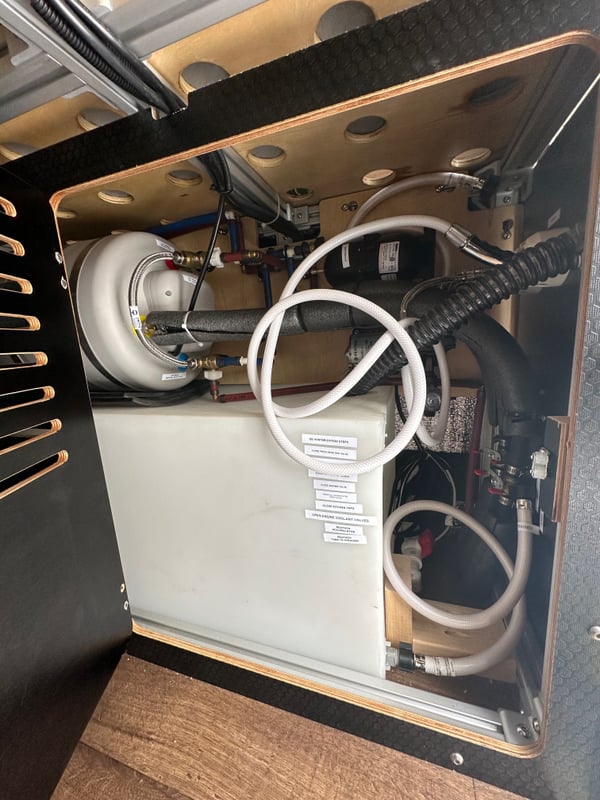
The builder installed an over-wheel-arch fresh water tank, an underslung gray water tank with an electric ball valve to dump it, and an Isotemp water heater that pulls heat from the engine coolant — hot water while you drive, no battery required. They also fitted an Espar diesel cabin heater under the passenger seat while they were in there.
A lot of people go the two-jug route: fresh water jug under the sink, gray water jug to catch the drain. It’s simple and it works, but it rules out hot water. Hot water was the thing we weren’t willing to give up, so we went with custom tanks and an outdoor shower on the back.
One thing worth knowing about the coolant tap: it adds a dependency. If you’d rather keep the plumbing and the engine completely separate, electrical-only heating is a sensible call.
Hot water
The Isotemp does what it says. After a drive the water’s properly hot, and it stays that way for about 12 hours before dropping to lukewarm. Since we’re driving most days that’s fine. For the days it isn’t, there’s a 400W heating element — 20 minutes off the battery and you’re back.
The sink is big and deep and was worth whatever it cost. Doing dishes in a camping-sized sink is genuinely miserable; doing them in this one is not.
Hot water also means you can do a rough wash inside the van — enough to feel human again — which buys more time between proper showers than you’d think.
Heating
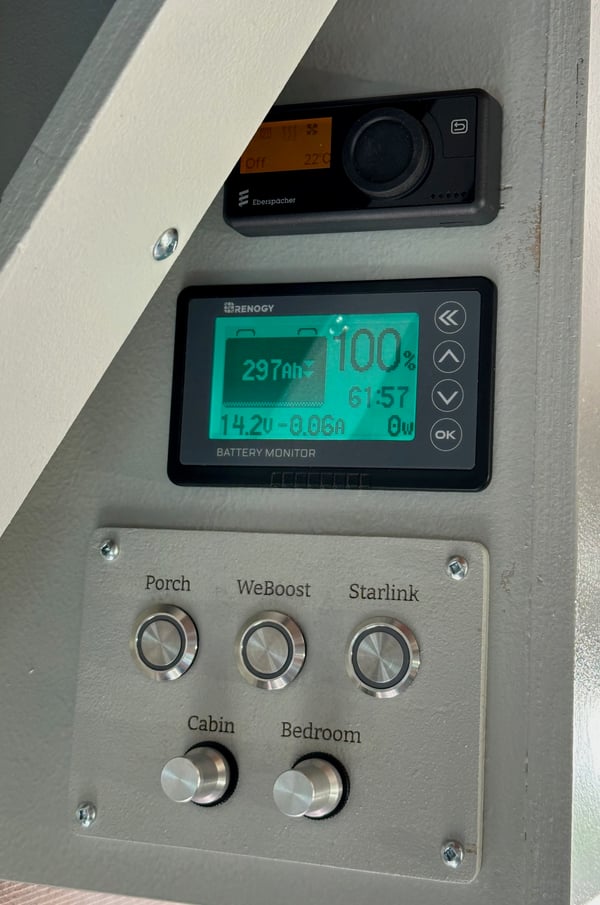
The Espar S2 is a 2kW diesel cabin heater, installed under the passenger seat — the standard spot in most Transit builds for clean ducting and exhaust routing. The thermostat lives mid-van in our control panel rather than up near the cab, which is where you want it: reading the temperature where you’re actually sleeping.
The heater is loud. We weren’t prepared for how loud. Not “you’ll notice it” loud — more “small jet engine spooling up in the same room” loud. It settles after a minute or two of running, and we may still sort out a proper muffler on the exhaust pipe rather than the straight pipe we have now. Fair warning either way.
It keeps the van genuinely warm though, and that’s what matters. We also keep a 12V electric blanket on board as a backup — van builds should have redundancy where possible, and a good electric blanket off the battery gets you through a cold night if the heater ever acts up.
Outdoor shower
The outdoor shower is a marine shower head with a mixer tap on the back of the van. When the weather cooperates it’s genuinely great — hot water, proper pressure, rinse the dog, wash your feet before getting back in. We have a rear door shower curtain rigged up that works, though we haven’t landed on a solution we’re completely happy with yet.
When it’s cold, the outdoor shower stays shut. What we do instead is navy washes at the sink inside: a focused rinse of everything that matters, no shower required. It sounds like roughing it. It keeps you surprisingly fresh. Better than wet wipes, which are themselves better than nothing.
Toilet
The toilet is a Cuddy composting toilet. It has a built-in fan and charcoal filter, and when it’s in its home in the van it doesn’t smell.
“Composting” is a bit aspirational as a description — what these actually are is separating toilets. Liquids go one way, solids go another, and the separation is what does the work. Solids dry out quickly and smell earthy rather than awful. We’ve gone something like six weeks with two people before needing to empty the solids container, though we weren’t using it every single day. Liquids need emptying every other day or so.
We previously had a Porta Potti 365 chemical toilet, which was honestly fine — not as grim to empty as you’d expect. The Cuddy is a meaningful step up, but the Porta Potti wasn’t the nightmare it sounds like.
What we’d say to anyone on the fence: having a toilet in the van is worth it. Being able to step out of bed in the middle of the night without tromping through a dark campground is the specific quality-of-life win that van life is supposed to deliver. We think it’s worth it.
One practical note: measure very carefully before you buy. Our Cuddy fit with millimetres of clearance against the drawer unit. If we’d built the bench slightly differently it wouldn’t have gone in at all.
Capacity and daily life
29 gallons fresh, 5 gallons in the Isotemp tank. About 34 gallons once everything’s full. As two people with a dog, that’s a comfortable five days. A week starts to require some thought.
Figuring out water capacity is harder than figuring out electrical. With electrical you can calculate loads and run times. With water it depends on how you cook, how you wash up, whether you’re using the outdoor shower. We landed where we did mostly by feel. It turns out five days also happens to be roughly how long we’d go before wanting to restock food, so the timing works out.
Drinking water
We have an inline activated carbon filter on the drinking water. It doesn’t make questionable water safe — you still need to fill from a potable source — but it takes the edge off any weird taste or smell, which matters when you’re filling from municipal taps that vary a lot in quality. If you want to go further, UV filtration systems will handle more serious water quality concerns. We didn’t feel we needed that, but it’s a real option.
What we’d do on van 2
We made a mistake installing a diesel heater on the petrol van. Originally this was to avoid needing to tap into the fuel tank (because we thought we were doing this all DIY) but the pro builder could have done this, and it would remove the diesel-vs-petrol complexity (and diesel smell!). We would also very likely add an interior shower. Some of that is just us getting older, some of it is that a shower cubicle doubles as a toilet room — right now the composting toilet pulls out from the bench seat and you use it in the open van, which involves occasionally asking the other person to take the dog for a walk right now please and knock before you come back in.